

Web scraping tools can make data collection faster and easier. Scrapingdog is a useful choice for developers who want a simple API for collecting data from websites. It can help with search results, product pages, LinkedIn data, and other online content. But it may not be the best fit for every project.
You may need stronger anti-bot protection, lower pricing, better proxy options, faster speed, or more advanced JavaScript rendering. There are many powerful tools that can help you collect web data more smoothly. Many are built for beginners, while advanced platforms are made for developers and large teams.
Top 10 Best Scrapingdog Alternatives in 2026
Looking for the best Scrapingdog alternatives? Many tools offer fast scraping, reliable proxies, and easy APIs. Here is the list of 10 strong options to help you collect web data with less effort and fewer blocks.
1. Bright Data

Bright Data is one of the most trusted names in web scraping and proxy services. It is used by thousands of companies worldwide, including large enterprises, universities, and data-focused teams. The platform has built a strong reputation over many years. It offers a wide range of tools for collecting public web data. These include residential proxies, datacenter proxies, ISP proxies, Web Unlocker, Scraping Browser, and ready-made datasets.
Bright Data is a strong choice for teams that need reliable data at scale. It handles many complex tasks, such as proxy rotation, CAPTCHA challenges, and browser fingerprinting. This helps teams save time and avoid technical problems. For businesses that need stable and accurate data, Bright Data remains a leading option.
Key Features:
- Proxy Pool: 150M+ residential IPs across 195 countries, the largest in the industry.
- Web Unlocker: Automatically handles CAPTCHAs, fingerprint rotation, and challenge-solving on protected sites.
- Scraping Browser: A full headless browser built for JavaScript-heavy, dynamic pages.
- Dataset Marketplace: Pre-collected datasets you can access instantly without running a single scrape.
- Certifications: SOC2, ISO 27001, and CSA STAR — essential for enterprise compliance requirements
Pros
- Unmatched proxy network size with 150M+ IPs and coverage in every country
- Dedicated account managers and 24/7 support for enterprise clients
- Pre-built Data Collectors for 120+ common targets, including Amazon and LinkedIn
- Trusted and certified for use in highly regulated industries
Cons
- Minimum spend of $499/month makes it inaccessible for smaller teams
- Setup complexity is high and requires engineering resources to manage properly
- Overkill for simple or low-volume scraping projects
Pricing: Pay-as-you-go from $4/GB for residential proxies; Growth plan starts at $499/month. Enterprise pricing available on request.
2. Scrapfly

Scrapfly is a strong alternative to Scrapingdog for teams that often face anti-bot blocks. It is cloud-based, so you do not need to install desktop software or keep a local browser running. You use it through a simple API, and it also supports SDKs for Python, TypeScript, Go, and Rust.
Its pricing is based on credits. This means costs depend on how difficult the target site is. A Cloudflare-protected page costs more, while a simple HTML page costs less. Scrapfly also includes AI extraction, smart session handling, and expert support from engineers who understand anti-bot systems. Overall, it is a cost-effective choice for high-performance web scraping.
Key Features:
- ASP (Anti-Scraping Protection) Engine: Full-stack bypass including TLS fingerprinting, Cloudflare, DataDome, and PerimeterX handling.
- Session Intelligence: Reuses unblocked browser sessions to reduce cost without sacrificing success rate.
- AI Extraction: LLM-powered data extraction with auto-detection and named templates for products, articles, and more.
- Variable Credit Pricing: Simple targets cost 1 credit; complex protected targets cost 30+ — you never overpay for easy pages.
- Cloud-Native API: No desktop software, no installation — works from anywhere with Python, TypeScript, Go, and Rust SDKs.
Pros
- 98% success rate on hard targets like Zillow, Glassdoor, LinkedIn, and Amazon
- Lower entry price than most comparable tools
- In-house technical support from engineers who built the underlying technology
- Credit pricing scales fairly with actual complexity, rather than with flat per-request fees
Cons
- Credit math can be confusing for new users when comparing plans
- Not the best option if all your targets are simple, unprotected pages
- Community and documentation are still maturing compared to older platforms
Pricing: Discovery plan at $30/month (200K credits); Pro at $100/month (1M credits); Startup at $250/month; Enterprise at $500/month.
3. ScrapingBee
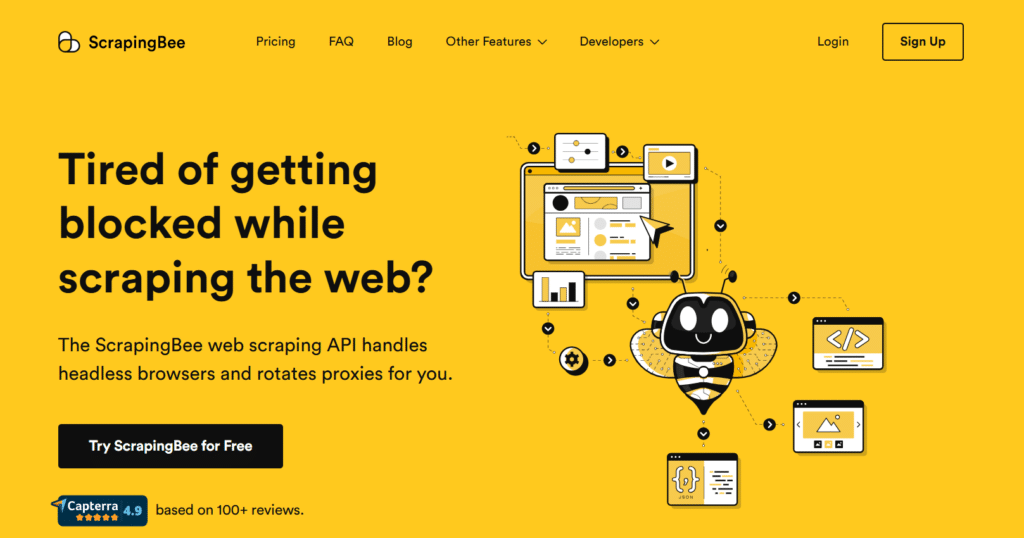
ScrapingBee is a simple and developer-friendly scraping API. It gives users access to important features on every plan, even the basic Freelance plan. You get JavaScript rendering, proxy rotation, CAPTCHA handling, screenshots, and Google SERP scraping without paying for a higher tier. This makes it easier to understand the pricing and choose a plan. ScrapingBee also supports AI-based data extraction. You can explain the data you need in normal language instead of using complex selectors. Its REST API is easy to use and works well with different tech stacks. New users can start with 1,000 free API calls without adding a credit card. It is a good option for developers who want fast setup and clear features.
Key Features:
- Flat Feature Access: Every plan tier includes JS rendering, proxy rotation, CAPTCHA handling, and screenshot capture.
- Google SERP API: Dedicated endpoint for scraping Google search results at scale.
- AI-Powered Natural Language Extraction: Extract specific data fields using plain English instructions.
- Built-in Table-to-JSON Parsing: Automatically converts HTML tables into structured JSON data.
- Declarative JavaScript Scenarios: Execute multi-step browser interactions through a simple API parameter.
Pros
- No locked features — the $49/month Freelance plan includes everything
- 1,000 free API calls available with no credit card required
- Simple, well-documented REST API that integrates quickly into any stack
- Straightforward concurrent request scaling from 10 to 200 across plans
Cons
- Independent benchmarks show weak performance on some protected sites like Glassdoor
- Not ideal for teams needing enterprise-level proxy infrastructure
- No dedicated account managers on lower-tier plans
Pricing: Freelance at $49.99/month (250K credits, 10 concurrent); Startup at $99/month (1M credits); Business at $249/month; Business+ at $599/month.
4. Apify

Apify is a cloud-based scraping platform with a large marketplace of ready-made scrapers. These scrapers are called Actors, and each one is built for a specific website or data source. You can find Actors for platforms like Instagram, TikTok, LinkedIn, Amazon, Google Maps, and Booking.com. This helps users collect data without building a scraper from scratch.
Apify runs fully in the cloud, so there is no software to install. API access is included on every plan, even the free plan, which includes monthly credits. Developers can also create custom Actors with Node.js or Python. Apify also supports scheduling, data storage, and integrations. It is a flexible choice for teams that need both ready-made and custom scraping tools.
Key Features:
- Actor Marketplace: 30,000+ ready-to-run scrapers maintained by a global developer community.
- Crawlee SDK: Full custom scraping framework in Node.js and Python for building your own Actors.
- Cloud Storage: Built-in dataset storage with export to JSON, CSV, XML, Excel, HTML, and RSS.
- Scheduling: Run any Actor on a recurring schedule — hourly, daily, weekly, or custom cron.
- Integrations: Native connectors for Zapier, Make, Slack, Google Drive, Airtable, and more.
Pros
- The Actor marketplace saves weeks of scraper development for popular targets
- Full cloud experience with no desktop software to install or maintain
- Generous free tier with $5/month in platform credits and no export limits
Cons
- Two-layer pricing (platform plan + per-Actor costs) can make spend difficult to predict
- Actor quality varies between community-built and officially maintained options
- Free credits don’t roll over from month to month
Pricing: Free ($5 credits/month); Starter at $29/month; Scale at $199/month; Business at $999/month; Enterprise custom.
5. ScraperAPI

ScraperAPI is a good choice for users who want a free, non-expiring scraping API. It offers 1,000 free credits each month, so teams can test real-world scraping tasks before buying a plan. The API is simple to use and built for developers. It can automatically manage proxy rotation, CAPTCHA solving, and JavaScript rendering.
ScraperAPI also offers a 99.9% uptime SLA, which adds more confidence for regular use. It supports geotargeting in multiple countries and batch processing for larger URL lists. New users also get extra requests during the first week. This makes ScraperAPI useful for startups, small teams, and developers with limited budgets. Users should still test speed and billing settings before scaling.
Key Features:
- Ongoing Free Plan: 1,000 credits per month with no time limit, renewable every month.
- Auto-Proxy Rotation: Every request automatically rotates through residential and datacenter proxies.
- 99.9% Uptime SLA: Published uptime guarantee unlike most comparable tools.
- Asynchronous Processing: Submit large batches of URLs for background processing and retrieve results via callback.
- Geotargeting: Route requests through IPs in 12 countries for localized data
Pros
- The most generous free plan in the market for ongoing testing and low-volume use
- Simple API design with clear documentation and code samples in major languages
- Published uptime SLA provides accountability that Scrapingdog doesn’t offer
- Pay-as-you-go billing available alongside subscription plans
Cons
- Benchmarks have flagged a 40-second average response time on Amazon — slow for high-volume jobs
- New Auto-Upgrade billing (introduced January 2026) can cause unexpected spend spikes
- Not suited for heavily protected targets without manual retry logic
Pricing: Free (1,000 credits/month ongoing); Hobby at $49/month (100K credits); Startup at $149/month; Business at $299/month.
6. Oxylabs

Oxylabs is a strong Scrapingdog alternative for enterprise scraping and proxy needs. It offers a large residential proxy network with coverage in many countries. Its Web Unblocker can manage common scraping challenges, such as CAPTCHAs, browser fingerprints, and JavaScript-heavy pages. Oxylabs also became stronger after acquiring ScrapingBee, adding a simpler API option for developers.
The platform is often praised for its clean dashboard and easier setup process. Many large teams also compare their pricing with Bright Data when negotiating proxy costs. However, Oxylabs is still built mainly for enterprise users. Smaller teams may find the pricing and minimum commitments too high. It is best for companies that need reliable infrastructure at scale.
Key Features:
- 175M+ Residential IPs: One of the largest proxy pools in the industry, comparable to Bright Data.
- Web Unblocker: Fully managed anti-bot solution with automatic challenge solving and fingerprint rotation.
- Flexible IP Tiering: Datacenter, residential, ISP, and mobile proxies under one account.
- Scraper APIs: Pre-built APIs for e-commerce, SERP, real estate, and travel data.
Pros
- Network scale matches Bright Data at a slightly lower starting price
- Smoother dashboard and onboarding experience compared to Bright Data’s setup complexity
- Broad IP quality options let you use cheaper datacenter proxies for easy targets
- Strong compliance certifications including GDPR and CCPA
Cons
- Still enterprise-level pricing — not a budget option for small teams
- Higher tiers require a sales conversation before you can access custom rates
- Less community documentation than developer-first alternatives
Pricing: Residential from $6/GB; Datacenter from $1.20/IP; Mobile at $7.50/GB; ISP from $1.60/IP. Entry commitment around $300/month.
7. Firecrawl

Firecrawl is designed for AI applications and modern machine learning workflows. The platform helps developers collect web content in clean markdown or JSON format. This removes the need for manual HTML parsing and extra data cleaning. It is especially useful for RAG systems, AI agents, and tools that rely on live web information.
Firecrawl has become popular in the developer community because it is open source and widely trusted. Many well-known companies use it in production environments. The platform also offers security standards important to enterprise teams. Users can start with free monthly credits without adding a credit card. Firecrawl also includes advanced automation features that can navigate websites and automatically return structured data.
Key Features:
- LLM-Ready Output: Every page is returned as clean markdown or structured JSON optimized for language models.
- Unified API: Search, scrape, crawl, and extract data through a single API key and endpoint.
- Browser Sandbox: Programmable browser for authentication flows, form submissions, and multi-step interactions via API.
- /agent Endpoint: Autonomous web research that navigates complex sites and returns structured results in minutes.
- Claude & n8n Integration: Official Claude plugin and seamless compatibility with n8n, Zapier, and Bubble.io
Pros
- One API key replaces the multi-product setup required with Bright Data or Scrapingdog for AI use cases
- Open source with 113K+ GitHub stars and an active contributor community
- SOC 2 Type II certified and trusted by Shopify, Apple, Canva, and Replit
- Generous free tier with 1,000 credits per month and no credit card required
Cons
- No datacenter proxy infrastructure — not a replacement for proxy-first tools
- Narrower scope than general-purpose scraping platforms
- Documentation and community are still growing compared to established players
Pricing: Free (1,000 credits/month); Hobby at $16/month; Standard at $83/month; Growth at $333/month; Scale at $599/month.
8. Nimble (Nimbleway)

Nimble is a strong option for teams that want simple scraping with powerful automation. It combines no-code features with AI tools and enterprise-level infrastructure. Business users can collect large amounts of data without depending on engineers for every change. Its AI system chooses the best request method for each website. It also handles headers, proxy logic, and anti-bot challenges automatically. Nimble can send collected data straight to S3, Google Cloud Storage, or Azure. This makes data delivery easier for large teams. It also supports batch processing for many URLs at once. Nimble is built for companies that need scale, reliability, and compliance. However, its higher starting price makes it less suitable for small teams or solo developers.
Key Features:
- AI Optimization Engine: Automatically selects the best approach for each target including routing, headers, and challenge resolution.
- Zero-Maintenance Pipelines: Fully automated data delivery with no manual workflow updates required.
- Direct Cloud Storage Integration: Deliver data straight to S3, Google Cloud Storage, or Azure without intermediate steps.
- Batch Processing: Run up to 1,000 URLs simultaneously on autopilot.
- Compliance Certifications: SOC 2, GDPR, and CCPA compliant for enterprise data governance requirements
Pros
- Achieves 92%+ success rates on difficult protected sites out of the box
- No-code interface means business users can run pipelines without engineering support
- Direct cloud storage delivery removes manual export and download steps
- Enterprise-ready compliance stack for regulated industries
Cons
- High entry price of $600+/month puts it out of reach for smaller teams
- Less flexibility for developers who want low-level control over request parameters
- Not suitable for casual or one-off scraping projects
Pricing: Start free with 5,000 pages; pricing begins at $3/1,000 pages for Agent API, $1.50/search input, $0.90/1,000 URLs, and $7.50/GB for residential proxies.
9. Octoparse

Octoparse is a simple web scraping tool for beginners and non-technical users. It allows you to build scrapers with a visual point-and-click editor. You can select data from a live webpage without writing code. The platform also includes many ready-made templates for popular websites like Amazon, LinkedIn, Zillow, Indeed, and Glassdoor.
Octoparse supports scheduled cloud extraction, so tasks can run automatically. Its free plan is useful for small projects and includes several tasks and monthly data rows. Users can export data in formats like CSV, Excel, JSON, HTML, and XML. Data can also be sent to Google Sheets. Octoparse is ideal for marketers, analysts, and founders, but complex sites may need extra manual adjustments.
Key Features:
- Visual Workflow Builder: Click on any element of a webpage to add it to your extraction template, no code required.
- 500+ Pre-Built Templates: Ready-to-run scrapers for the most common data sources including e-commerce, job boards, and social platforms.
- Cloud Extraction: Schedule scrapers to run automatically in the cloud 24/7 without keeping your computer on.
- IP Rotation: Built-in proxy rotation on all paid plans to reduce blocks.
- Multi-Format Export: Download data as CSV, Excel, JSON, HTML, or XML, or push directly to Google Sheets.
Pros
- Genuinely zero-code — anyone can build and run a scraper in minutes
- The most generous free plan among no-code tools (10 tasks, 50K rows/month)
- Fast time-to-data for stable, well-structured target websites
- Strong template marketplace reduces setup time for common use cases
Cons
- Desktop app is required for building scrapers — no fully cloud-based development experience
- Struggles with Cloudflare, DataDome, and other advanced anti-bot systems
- Layout changes on target sites frequently break existing scrapers and require manual fixes
Pricing: Free (10 tasks, 50K rows/month); Standard at $69/month (annual) or $89/month; Professional at $249/month; Enterprise custom.
10. SOAX
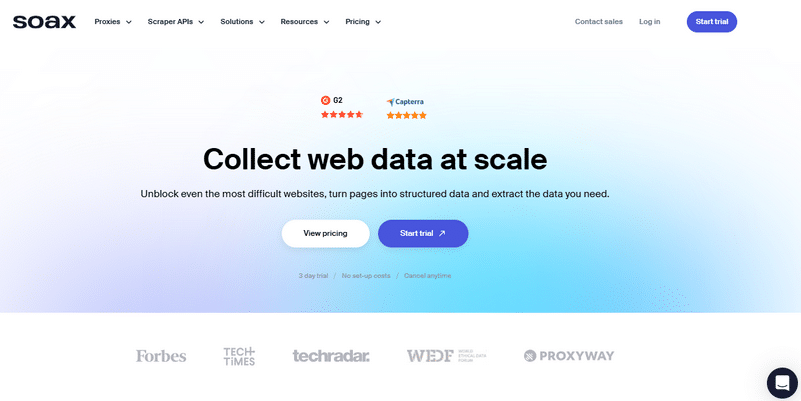
SOAX is primarily a proxy platform, but it also offers a Web Data API for scraping. It has a large pool of residential IPs with wide country coverage. This makes it useful for teams that need location-based data collection. SOAX supports both sticky sessions and rotating IPs, depending on the scraping use case. It also provides ISP and mobile proxies for harder targets.
The Web Data API can handle JavaScript rendering and some anti-bot issues. Users can test the platform with a low-cost short trial before choosing a monthly plan. SOAX works best when your scraper is already built and you mainly need better proxies. It is less suitable as a complete scraping platform.
Key Features:
- 155M+ Residential IPs: Large, ethically-sourced proxy pool covering 195 countries.
- Web Data API: Managed scraping API that handles JS rendering and anti-bot measures on top of the proxy network.
- Flexible Rotation: Configure sticky sessions or rotating IPs per request based on your needs.
- ISP and Mobile Proxies: Access to ISP-level and mobile IPs for targets that specifically block datacenter traffic.
- Pay-Per-Use Option: A $1.99 three-day trial allows hands-on testing before any monthly commitment
Pros
- The large residential IP pool makes it well-suited for high-volume, geo-targeted scraping
- Flexible session management gives developers fine-grained control over IP behavior
- Lower entry price for the Web Data API than comparable enterprise proxy tools
- Affordable trial with real access (not just a feature-limited sandbox)
Cons
- Primarily a proxy provider — the scraping API is a secondary offering, not the core product
- Less developer tooling and documentation than API-first platforms like Scrapfly or ScrapingBee
- Support can be slower outside business hours
Pricing: Web Data API plans start at $1.30 per 1K requests, $90/month for 36K requests. Residential proxies from $3.60/GB. Three-day trial available for $1.99.
Summary Table
| # | Brand / Tool | Type (as described) | Best for (from article) | Notable capabilities mentioned | Free tier / trial (as stated) | Starting price (as stated) |
|---|---|---|---|---|---|---|
| 1 | Bright Data | Enterprise proxies + scraping platform | High-scale, reliable scraping with strong anti-bot + compliance | 150M+ residential IPs; Web Unlocker; Scraping Browser; dataset marketplace; SOC2/ISO/CSA STAR | Not mentioned | PAYG from $4/GB (residential); plans from $499/mo |
| 2 | Scrapfly | Anti-bot focused scraping API | Hard targets & anti-bot bypass with “credits by complexity” | ASP engine (TLS fingerprinting; Cloudflare/DataDome/PerimeterX); session intelligence; AI extraction; variable credit pricing; SDKs | Not mentioned | $30/mo (Discovery) |
| 3 | ScrapingBee | Developer scraping API | Clear feature access + fast setup; JS rendering on all plans | JS rendering; proxy rotation; CAPTCHA handling; SERP API; AI NL extraction; table-to-JSON; JS scenarios | 1,000 free API calls (no CC) | $49.99/mo (Freelance) |
| 4 | Apify | Cloud scraping platform (Actors) | Ready-made scrapers + scheduling in the cloud | 30,000+ Actors; Crawlee SDK; dataset storage/export; scheduling; many integrations | Free: $5 credits/month | $29/mo (Starter) |
| 5 | ScraperAPI | Developer scraping API | Ongoing free credits + simple API for general scraping | 1,000 credits/month free; auto proxy rotation; JS rendering; async processing; geotargeting (12 countries); 99.9% uptime SLA | Free: 1,000 credits/month (ongoing) | $49/mo (Hobby) |
| 6 | Oxylabs | Enterprise proxy + scraping platform | Enterprise infra + Web Unblocker; proxy tiering | 175M+ residential IPs; Web Unblocker; datacenter/residential/ISP/mobile tiers; scraper APIs | Not mentioned | Residential from $6/GB (entry commitment ~ $300/mo) |
| 7 | Firecrawl | Developer API for AI workflows | LLM-ready markdown/JSON + agent automation | Unified API; browser sandbox; /agent endpoint; Claude + n8n integration | Free: 1,000 credits/month | $16/mo (Hobby) |
| 8 | Nimble (Nimbleway) | AI-driven enterprise scraping platform | No-code enterprise pipelines with direct cloud delivery | AI optimization engine; zero-maintenance pipelines; S3/GCS/Azure delivery; batch up to 1,000 URLs; SOC2/GDPR/CCPA | “Start free with 5,000 pages” | Pricing begins at $3/1,000 pages (Agent API) (plus other rates listed) |
| 9 | Octoparse | No-code visual scraping tool | Beginners wanting templates + cloud scheduling | Visual builder; 500+ templates; cloud extraction; IP rotation on paid plans; multi-format export | Free plan (10 tasks, 50K rows/mo) | $69/mo (annual) / $89/mo (Standard) |
| 10 | SOAX | Proxy provider + Web Data API | Teams that mainly need proxies + managed API | 155M+ residential IPs; Web Data API (JS + anti-bot); sticky/rotating sessions; ISP + mobile proxies; pay-per-use trial | 3-day trial for $1.99 | Web Data API from $1.30 per 1K requests (also $90/mo for 36K requests) |
Final Words
Choosing the right Scrapingdog alternative depends on your budget, technical skills, and scraping needs. Some tools focus on enterprise-level performance, while others are better for beginners or small teams. Platforms like Bright Data and Oxylabs are strong choices for large-scale projects. ScrapingBee and ScraperAPI work well for developers who want simple APIs and easy setup. Octoparse is ideal for no-code users, while Firecrawl is built for AI and modern data workflows. Every tool on this list offers different strengths, pricing models, and features. Before making a final decision, test the platform with your real scraping targets and compare performance, reliability, and ease of use.






Leave a Comment
Required fields are marked *